
|
Doppler Effect
The same effect occurs when an object reflecting light moves
relative to an observer. When approaching, the observed frequency
is greater than that being emitted, when receding, it is less. We
perceive this frequency shift as a change in the colour of the
object. A higher frequency (object approaching) corresponds to a
bluer colour, a lower frequency (object receding) to a redder
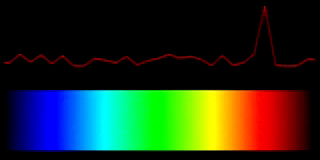
colour. In the example spectrum of a green object shown below,
moving towards it would cause the line to shift to the left,
causing a spike in the blue region, while moving away from it
would shift the spike to the right, placing more energy in the red
region. 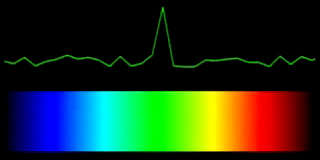 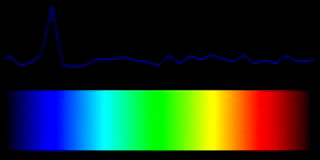
However, visible light is only a small part of the electromagnetic spectrum. If an observer were to recede from a red-coloured object at a great enough speed, the object would seem to be emitting predominantly infra-red radiation (heat) and would therefore not be visible. Similarly, if the observer were to approach a blue object fast enough, the blue would be shifted into the ultraviolet region and the object would appear darkened.
The following table shows how objects of different colours would
appear to an observer if the magnitude of their relative motion
was around 25% light speed.
|